Rimac Nevera review: 1,888-hp electric hypercar bows out of production
British magazine evo has tested the Rimac Nevera, which ends production this year. The Croatian hypercar won praise not only for its staggering performance but also for how it feels to drive.
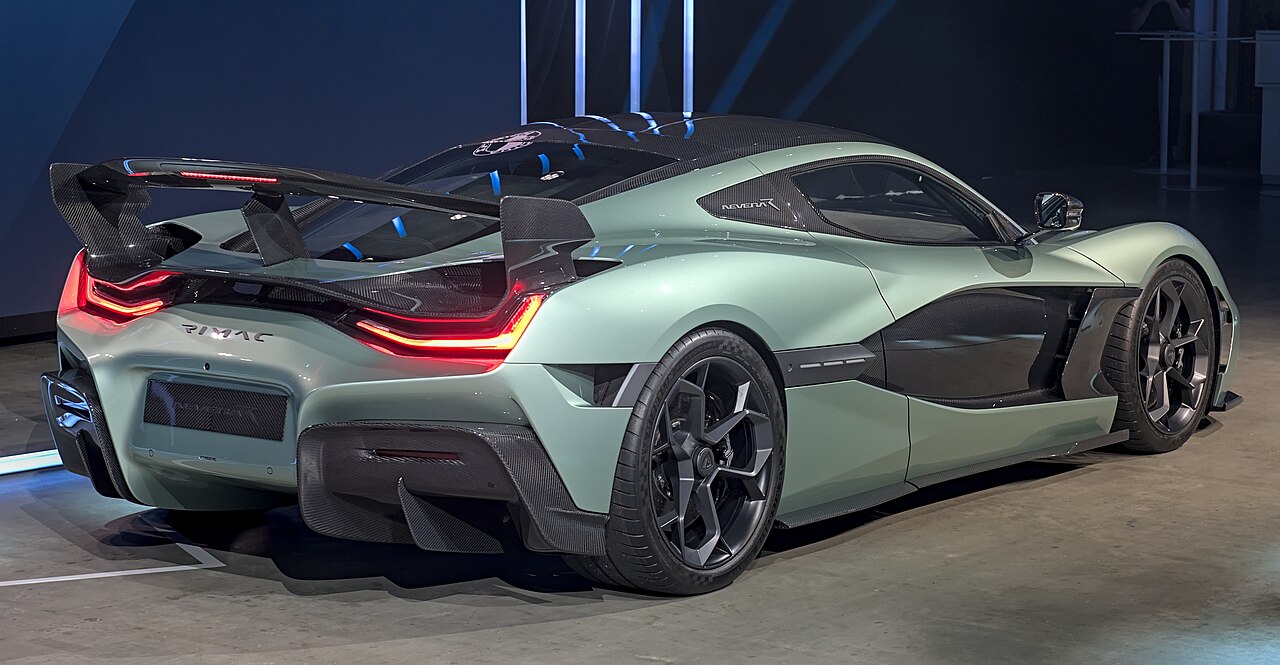
Years after its launch, Croatian manufacturer Rimac's electric hypercar, the Nevera, remains one of the benchmarks in its segment. According to an in-depth review by British car magazine evo, the model impresses its driver not just with its straight-line speed but also with its cornering and braking performance. Production of the Nevera will end this year. In the United Kingdom, prices start at £1,720,000.
Four motors, four gearboxes
At the heart of the Nevera is a carbon fiber body. The 120 kWh battery mounted in the floor gives the car a near 50:50 weight distribution. The 730-volt system contains 6,960 liquid-cooled cylindrical cells. Although the car is heavy at 2,150 kilograms, keeping the mass low pays off in the way it drives.
Each wheel is driven by its own electric motor and gearbox. The front motors produce 295 hp each, while the rear units make 644 hp each. Total output is 1,888 hp, with 1,739 lb-ft of torque. At the rear, two single-speed gearboxes share a common housing. The suspension uses double wishbones and electronically adjustable dampers at each corner.
According to the manufacturer, the Nevera completes 0-60 mph in under 1.8 seconds and 0-100 mph in 4 seconds. The quarter mile takes 8.6 seconds, and 300 km/h arrives in less than 10 seconds. Top speed is 258 mph. The test driver reports that when reaching 180 mph on a closed road, the car was still pulling as hard as it did at 50 mph, and notes that the Nevera made even the Bugatti Chiron Super Sport, brought along for comparison, feel slow.
Electronic control, analog feel
The model has five drive modes: Range, Cruise, Sport, Track and Drift. Each mode offers different settings for the dampers, throttle response, stability control, steering and aerodynamics. Hydraulic wings and ducts at the front, rear and underbody deploy automatically in response to acceleration, braking and cornering. The carbon-ceramic brakes, with six-piston calipers, are electronically controlled, but continue to work conventionally in the event of a system failure. The review stresses that the engineers worked at length to make the brake feel natural.
The charging figures are equally ambitious. The battery can go from nearly empty to full in under 20 minutes, and around 300 miles of range can be added in about 18 minutes.
Standout rivals include the Lotus Evija, which costs £1.75 million and offers up to 2,000 hp; the Pininfarina Battista, which shares the same platform; and the Yangwang U9 Xtreme, with more than 3,000 hp. The Nevera's success has paved the way for company founder Mate Rimac's new ventures, including a V16-powered project.
Photos 2
Photos from Wikimedia Commons, used under their free licences.
This article was compiled with the help of AI from information published by evo.